
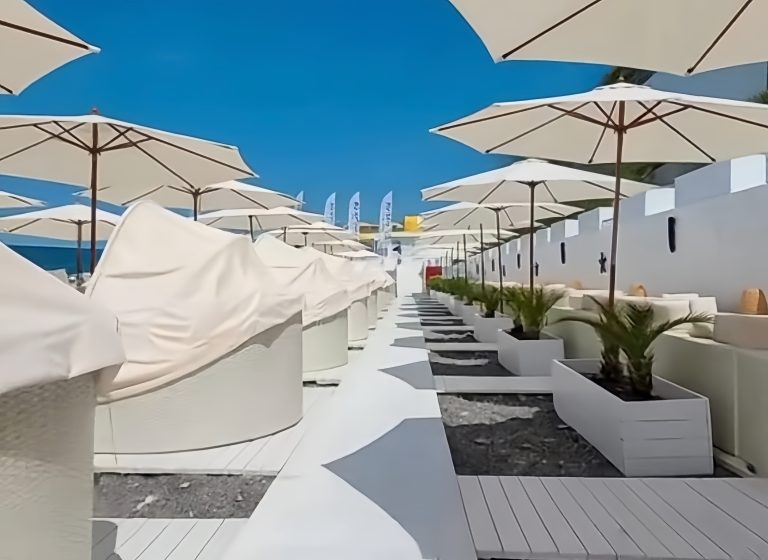
Such examples are often encountered in the procurement industry., a luxury resort chain in the Mediterranean placed an urgent order for 800 custom LED outdoor umbrellas to debut at its summer reopening. The marketing team promised guests “ambient-lit shade by night, solar-powered sustainability by day.” The procurement team contacted suppliers in March, expecting delivery by late May.
Table of Contents
ToggleBy June, only 120 units had arrived—and half failed during the first rainstorm. The cause? The factory skipped proper waterproofing validation to meet the rushed deadline. The resort had to deploy generic non-LED umbrellas, damaging brand credibility and triggering costly last-minute replacements.
This wasn’t a supplier failure—it was a planning failure. Too many buyers treat LED outdoor umbrellas as simple promotional items, not engineered electromechanical systems designed to survive sun, rain, wind, and daily human interaction.
Unlike standard patio umbrellas, LED outdoor models integrate sealed electronics, certified power systems, UV-resistant materials, and precision tooling—each adding layers of complexity, compliance, and time.
This guide provides a transparent, actionable roadmap for planning bulk orders—so you never miss a season, event, or customer expectation again.
Why LED Outdoor Umbrellas Are Not “Just Umbrellas with Lights”
At first glance, an LED outdoor umbrella appears straightforward. But “outdoor” implies environmental resilience, which demands engineering rigor:
- IP65–IP67-rated enclosures to prevent water ingress during storms,Waterproofing is achieved through meticulous electronics potting, protecting internal sensors from high humidity.
- Conformal-coated circuit boards to resist humidity and salt corrosion
- Marine-grade wiring and sealed connectors
- UV-stabilized polymers for handles and housings (standard ABS yellows and cracks)
- Certified lithium batteries compliant with UN38.3, IEC 62133, and transport regulations
- Custom injection molds for ergonomic, watertight designs
Each of these elements requires design validation, component sourcing, safety certification, and multi-stage assembly. Skipping any step risks field failures, safety hazards, or customs rejections.
Key Insight: The more “weatherproof” and “feature-rich” your umbrella, the longer the lead time—because durability is engineered, not assembled.
Realistic Lead Time Breakdown (Bulk Orders: 500–10,000+ Units)
Below is a typical end-to-end timeline for a custom-branded LED outdoor umbrella manufactured in Asia—the dominant production region for this product category.
| Phase | Duration | Key Activities | Common Delays |
|---|---|---|---|
| 1. Design Finalization & Engineering Review | 1–3 weeks | Confirm canopy size, pole diameter, LED zones, battery type, IP rating, branding method | Frequent spec changes; unclear waterproofing requirements |
| 2. Mold & Tooling Fabrication | 3–6 weeks | CNC machining of steel molds for handle, pole caps, LED housings | Complex geometry; soft-touch coating adds time |
| 3. Pre-Production Samples (T1/T2) | 2–4 weeks | Build trial units, test sealing, brightness, battery life, drop resistance | Multiple revision cycles due to untested assumptions |
| 4. Component Sourcing & Certification | 2–5 weeks | Procure LEDs, PCBs, batteries; validate UN38.3, MSDS, CE/FCC if needed | Battery certification backlogs; chip shortages |
| 5. Mass Production | 3–6 weeks | Fabric cutting, frame welding, electronics potting, final assembly | Shared production lines; labor turnover; QC failures |
| 6. Quality Control & Packaging | 1–2 weeks | AQL 2.5 inspection, IP67 water jet test, custom box printing | Failed waterproofing tests; packaging redesign |
| 7. Shipping & Customs Clearance | 4–8 weeks | FCL/LCL sea freight, destination customs, inland logistics | Missing battery docs; port congestion |
Total Timeline: 16–34+ weeks from purchase order to warehouse receipt.Take for example,Scale can affect timing; a Giant Starlight Umbrella (LED 8-10m) requires longer assembly cycles due to its massive canopy size.
Reality Check: If a supplier quotes “6–8 weeks,” they’re likely selling in-stock, non-custom units—or omitting critical steps like mold making, certification, or IP testing.Note that the total timeline for cantilever models may extend further due to the mechanical complexity of the rotation arm.
Four Factors That Dictate Your Actual Timeline
Not all projects are equal. These variables determine your real lead time:
1. Degree of Customization
- Stock Model (No Changes): 8–12 weeks (if inventory exists)
- Semi-Custom (Logo + Color Swap on Existing Design): 12–18 weeks
- Fully Custom (New Shape, Solar Integration, RGB Logic): 20–34+ weeks,For the most advanced automation features, explore our range of all-electric outdoor umbrellas which integrate motorized opening and closing.
Example: Adding a solar panel isn’t just “stick it on top.” It requires waterproof mounting, charge controller integration, overcharge protection, and additional safety validation—adding 3–5 weeks.
2. Battery Type & Compliance Burden
- Non-rechargeable (Alkaline/CR123): Minimal regulation; faster shipping
- Rechargeable Li-ion/Polymer: Requires UN38.3, MSDS, IEC 62133, and sometimes CE/FCC—adding 2–4 weeks if not pre-certified
Warning: Non-compliant batteries risk shipment seizure under IATA Dangerous Goods Regulations (DGR). Always verify certification before PO issuance.
3. Order Volume & Factory Capacity
- 500–2,000 units: Often produced alongside other orders; may wait for line availability
- 5,000+ units: Dedicated production run—but requires full engineering sign-off and larger deposit
4. Seasonal Manufacturing Cycles
- Peak Season (August–December): Factories booked 3–4 months in advance
- Chinese New Year (Late January–February): 2–4 week shutdown; supply chains freeze
- Ideal Ordering Window: September–November for Q2/Q3 launches
Pro Tip: Avoid placing POs in December—factories rush to close books before CNY, increasing error rates and cutting corners.
The Sample Trap: Where Timelines Derail
Many buyers assume samples arrive in 7 days. In reality, the sample phase is the #1 cause of delays.
A typical sample workflow:
- Factory builds T1 sample using prototype molds → 10–14 days
- Ships via DHL/FedEx → 4–6 days
- Client tests in real conditions (rain simulation, thermal cycling, battery drain) → 7–10 days
- Requests changes (e.g., brighter LEDs, better seal, softer fabric) → factory reworks → another 10–14 days
Two revision cycles = 6+ weeks lost before mass production even begins.
Best Practice: Use 3D renders, material swatches, and existing catalog models to minimize physical iterations. Freeze specs early. Limit samples to one revision round.
A 6-Month Production Planning Framework
To ensure on-time delivery, plan backward from your must-have deployment date:
Month 6: Project Definition
- Finalize: canopy diameter (e.g., 9 ft), pole height, number of LED zones, color temperature (3000K vs 6000K), battery life (8h vs 12h), IP rating
- Decide: branding method (screen print, heat transfer, woven label)
- Select 2–3 pre-vetted suppliers with proven experience in outdoor-rated LED products
Month 5: PO Issuance & Tooling Kickoff
- Issue PO with clear milestones, payment terms, and delay penalties
- Approve 3D CAD models and mold designs
- Factory begins steel mold fabrication (typically 30–45 days)
Month 3.5: Sample Validation
- Receive and test T1 samples under simulated outdoor conditions
- Verify: no flickering after rain test, handle remains cool during extended use, full brightness at low battery
- Approve or request minimal changes
- A reliable LED Patio Umbrella with Solar Lights must undergo 72 hours of continuous salt spray testing during the validation phase.
Month 3: Mass Production Start
- Factory sources certified components (batteries, LEDs, fabrics)
- Begins canopy cutting, frame welding, electronics potting, and final assembly
- Schedule third-party pre-shipment inspection (e.g., QIMA, SGS)
Month 1.5: Final QC & Packaging
- Conduct AQL 2.5 inspection (critical for electronics)
- Test 5% of units for IP67 compliance via high-pressure water jet
- Approve custom packaging (retail box, hang tags, multilingual user manual)
Month 0.5: Shipping & Customs Prep
- Load container; provide commercial invoice, packing list, battery certifications
- Share HS code (typically 6601.91 for umbrellas with integrated electronics)
- Track vessel; prepare for destination customs clearance
Buffer Rule: Always add a 2–3 week contingency for unforeseen delays—port strikes, weather disruptions, or last-minute QC failures.
How to Accelerate Without Compromising Safety
While you can’t eliminate complexity, you can optimize:
✅ Leverage Existing Platforms
Ask: “Do you have an IP67-rated LED outdoor umbrella we can rebrand?” Adapting avoids new molds—saving 4–6 weeks.
✅ Pre-Qualify Batteries
Work only with suppliers who already hold valid UN38.3/MSDS for their battery packs. Avoid “custom” battery configurations unless essential.
✅ Standardize Early
Lock decisions on fabric GSM, LED density, switch type, and charging port before PO issuance. Every change = delay.
✅ Use Air Freight for Samples
Pay $200 for DHL instead of waiting 3 weeks for sea mail. Faster feedback = faster approval.
✅ Choose FOB Terms
FOB (Free On Board) shifts export logistics burden to the supplier—reducing your documentation risk and coordination overhead.
Red Flags That Signal Timeline Risk
During supplier vetting, watch for:
- “We can ship in 4 weeks”—ignores tooling and certification
- No photos of in-house mold shop or waterproofing lab
- Vague answers about IP testing methodology (“It’s waterproof—we tested it”)
- Samples shipped in plain plastic bags with no QC report
- Refusal to share a Gantt chart or milestone schedule
Remember: A competent supplier welcomes detailed questions—because they’ve managed complex outdoor electronics before.
Case Study: On-Time Municipal Installation
A U.S. city planned to install 1,500 solar-LED outdoor umbrellas in downtown plazas for a summer arts festival.
Their Plan:
- October (T – 6 months): Selected semi-custom model (existing IP67 handle, custom city logo)
- November: Approved 3D render; placed PO; paid 50% deposit
- December: Received T1 sample; approved with minor tweak (switch tactile feel)
- January: Mass production began post-CNY
- March: Passed IP67 water test and AQL inspection; shipped FCL
- May: Installed on schedule; zero failures during 3-month pilot
Success Drivers: Minimal customization, early engagement, and insistence on third-party IP validation.
Final Thought: Time Is the Currency of Reliability
In LED outdoor umbrella procurement, speed and reliability are inversely related. Rushing leads to condensation in handles, corroded contacts, flickering lights, or worse—battery safety incidents. Patience enables engineering rigor, proper testing, and brand-safe deployment.
When you understand that every week of lead time serves a purpose—mold precision, seal integrity, battery safety—you stop chasing unrealistic promises and start building resilient, predictable timelines.
Because your guests, citizens, or customers don’t care about your supply chain. They care that the umbrella works—rain or shine, night after night.
So plan backward. Ask hard questions. Respect the craft.
And never let a glossy catalog photo override the physics of outdoor electronics.
Need help mapping your LED outdoor umbrella production schedule?
Share your launch date, quantity, and key requirements (e.g., solar, RGB, logo placement, IP rating). We’ll provide a realistic timeline, vetted manufacturer shortlist, and a risk-mitigation checklist—so you deploy with confidence, not hope.
FAQ: LED Outdoor Umbrella Lead Times
1. Can I get them in 8 weeks?
Only if ordering in-stock, non-custom units under 300 pieces. Bulk custom orders need 14+ weeks.
2. Does “waterproof” mean IP67?
Not necessarily. Demand third-party IP67 test reports—not marketing claims.
3. What’s the biggest delay factor?
Tooling and sample revisions—not production capacity.
4. Should I pay 100% upfront?
No. Standard: 30–50% deposit, balance after QC approval.
5. Can I split shipments?
Possible, but increases per-unit cost and complicates logistics. Not recommended for first orders.
6. How do I verify waterproofing?
Require video of IPX6/IPX7 test: high-pressure water jet from multiple angles while powered on.
Standards Referenced:
- IEC 60529 (IP Ratings)
- UN Manual of Tests and Criteria (UN38.3 for lithium batteries)
- IEC 62133 (Safety for portable sealed cells)
- ISO 2859-1 (AQL Sampling Procedures)
- IATA Dangerous Goods Regulations (DGR)
(All publicly accessible as of January 2026.)


